The
natural religion of the McGinley clan was Irish Catholic, often
called the Celtic Church. This was the case from the beginning of
the Christian period up until roughly the end of the fifteenth century
and the early sixteenth century. From this point Rome enforced its
rule harder on the so called ‘wayward’ Irish. Prior
to this, the Irish had a reputation as unruly or disobedient Catholics
who didn’t always follow the rule of Rome. The Irish Catholicism
form had a much closer relationship with the natural world. You
could say that it was a mixture of Catholic and pagan beliefs. This
was the church of St Colm Cille, St Bridget and even St Patrick
(it is well documented that he ‘adapted’ his teaching
methods to fit in with the earlier pre-Christian and 'Irish' Christian
beliefs). Historically, Irish Priests and Monks were much closer
to the natural world compared to our modern counterparts. They even
were allowed to take a wife (often more than one but not at the
same time!) as seen in one of our earliest ancestors Ciothruadh
Mag Fhionnghail. This ironically takes things closer to the modern
Protestant religions!. The actions of the early Irish clergy were
a constant thorn in the side of the mainstream Roman Catholic thinking
in Rome. Rome had made many attempts to control our form of Christianity
since the 1200's.
An
Cathach
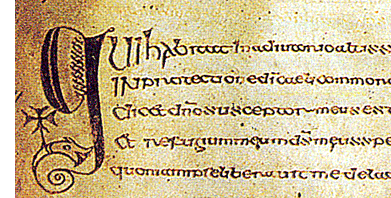 An
Cathach meaning ‘the Battler’, was a very important
relic used by the chief Donegal clan of Ó Domhnaill/O’Donnell.
It was used as a rallying cry and protector in battle. It was said
to protect and guarantee victory in war to the Donegal leaders.
Before a battle it was customery for a chosen monk/holy man (usually
attached to the O'Roarty clan, and someone who was sinless) to wear
the Cathach around his neck and then walk three times around the
troops of O’Donnell! All of the Donegal clans… the seed
of Conall… from Tír Chonaill, the land of Conall held
this book in high esteem. It is the oldest surviving book/manuscript
in Ireland, and the second oldest collection of the Psalms in the
world. It is a Latin psalter, of the Psalms, attributed to St Colm
Cille. The name of the book derives from the Irish Gaelic word cath
(pronounced KAH) meaning ‘battle’. An Cathach means
‘the battler’. The hereditary protectors/keepers of
An Cathach were the Ó Robhartaigh/O’Roarty clan from
north Donegal. The original is still intact, as is the casket in
which it was carried. An Cathach, the Battler, has been confidently
dated to around the period 590 AD to 600 AD. It has 58 surviving
folios which contain Psalms 30:10 to 105:13 (Vulgate version). It
is a manuscript on vellum. It was enclosed in a specially made shrine
sometime in the 1000's. This was done by Cathbharr Ó Domhnaill,
chief of the O'Donnells and Domhnall Mag Robhartaigh, the Abbot
of Kells. The shrine cover consists of a brass box measuring 9 inches
long, 8 inches wide and 2 inches thick. The top is heavily decorated
with silver, crystals, pearls and other precious stones. It shows
an image of the Crucifixion and an image of St Colm Cille. The decoration
throughout An Cathach is limited to the initial letters of each
psalm. An Cathach is now housed in the Royal Irish Academy (entrusted
to them in 1842) with who's kind permission we show an image of
it here. The specially made shrine, of great decoration, is housed
in the National Museum of Ireland. After the Battle of Kinsale in
1601, An Cathach found its way to the Continent (for safe keeping)
with some Irish Chieftains, possibly with the 'Flight of the Earls',
but this cannot be proved. Amazingly, for at least one hundred years
(possibly much longer), this priceless Irish relic was used as a
cure of eye ailments in cattle by superstitious farmers. They would
put the manuscript in water (yes water) and then touch the eyes
of the animal with it! Whether the cure worked or not we cannot
say, but this practice is the main reason for the poor condition
of much of the manuscript today.
An
Cathach meaning ‘the Battler’, was a very important
relic used by the chief Donegal clan of Ó Domhnaill/O’Donnell.
It was used as a rallying cry and protector in battle. It was said
to protect and guarantee victory in war to the Donegal leaders.
Before a battle it was customery for a chosen monk/holy man (usually
attached to the O'Roarty clan, and someone who was sinless) to wear
the Cathach around his neck and then walk three times around the
troops of O’Donnell! All of the Donegal clans… the seed
of Conall… from Tír Chonaill, the land of Conall held
this book in high esteem. It is the oldest surviving book/manuscript
in Ireland, and the second oldest collection of the Psalms in the
world. It is a Latin psalter, of the Psalms, attributed to St Colm
Cille. The name of the book derives from the Irish Gaelic word cath
(pronounced KAH) meaning ‘battle’. An Cathach means
‘the battler’. The hereditary protectors/keepers of
An Cathach were the Ó Robhartaigh/O’Roarty clan from
north Donegal. The original is still intact, as is the casket in
which it was carried. An Cathach, the Battler, has been confidently
dated to around the period 590 AD to 600 AD. It has 58 surviving
folios which contain Psalms 30:10 to 105:13 (Vulgate version). It
is a manuscript on vellum. It was enclosed in a specially made shrine
sometime in the 1000's. This was done by Cathbharr Ó Domhnaill,
chief of the O'Donnells and Domhnall Mag Robhartaigh, the Abbot
of Kells. The shrine cover consists of a brass box measuring 9 inches
long, 8 inches wide and 2 inches thick. The top is heavily decorated
with silver, crystals, pearls and other precious stones. It shows
an image of the Crucifixion and an image of St Colm Cille. The decoration
throughout An Cathach is limited to the initial letters of each
psalm. An Cathach is now housed in the Royal Irish Academy (entrusted
to them in 1842) with who's kind permission we show an image of
it here. The specially made shrine, of great decoration, is housed
in the National Museum of Ireland. After the Battle of Kinsale in
1601, An Cathach found its way to the Continent (for safe keeping)
with some Irish Chieftains, possibly with the 'Flight of the Earls',
but this cannot be proved. Amazingly, for at least one hundred years
(possibly much longer), this priceless Irish relic was used as a
cure of eye ailments in cattle by superstitious farmers. They would
put the manuscript in water (yes water) and then touch the eyes
of the animal with it! Whether the cure worked or not we cannot
say, but this practice is the main reason for the poor condition
of much of the manuscript today.
There
is no doubt that the early Irish Church, both in Ireland and in
Scotland allowed marriage among priests and monks. There are many
historical examples of this, including our own Ciothruadh Mag Fhionnghail.
Concubines were also common. Many Irish and Scottish surnames, of
Gaelic origin, attest to this. Examples are, Gillespie/Mac Giolla
Easbuig (son of the bishop), McAleese/Mac Giolla Íosa (son
of the follower of Jesus), McAnespie/Mac an Easbuig (son of the
bishop), McEvanny/Mac an Mhanaigh (son of the monk), Nerney/Mac
an Airchinnigh (son of the erenagh), McNabb/Mac an Aba (son of the
abbot), McPherson/Mac an Phearsúin (son of the parson), Taggert/Mac
an tSagairt (son of the priest), McVicar/Mac an Bhiocaire (son of
the vicar), Monaghan/Ó Manacháin (descendant of the
monk), Mullan/Ó Maoláin (descendant of the tonsured
one), Prior/Mac an Phríora (son of the prior) and many many
more.
The
respected writer Magnus Magnusson expressed things perfectly in
his book “Lindisfarne, the Cradle Island” when he clearly
defined the differences between the Irish/Celtic Church and the
Roman Church….”Celtic monks lived in conspicuous poverty;
Roman monks lived well, Celtic monks were unworldly; Roman monks
were worldly, Celtic bishops practiced humility; Roman bishops paraded
pomp, Celtic bishops were ministers of the flock; Roman bishops
were monarchs of their diocese, Celtic clergy said ‘Do as
I do (and hoped to be followed)’; Roman clergy said ‘Do
as I say (and expected to be obeyed)’. The final fall of the
Irish/Celtic Church co-incided with the fall of the Brehon Laws
in the early 1600’s. The McGinley clan thereafter adapted
to become Roman Catholics and remained staunchly Roman Catholic
thereafter. For centuries the Irish have fought for their Catholic
heritage during many centuries of religious and cultural oppresion.
ST
PATRICK
 Tradition
tells us that St Patrick travelled throughout Ireland on his evangelical
mission and found a devout people who respected the land and the
nature around them. St Patrick had to adapt his teaching methods
to take into account the strong aspect of nature among the Irish.
That is why he used the shamrock as a way of explaining the Trinity.
Tradition tells us that St Patrick, a Romanised Celt, came to Donegal
and famously baptised both Conall and Eoghan and therefore giving
his blessing to their descendants which would included the McGinleys.
St Patrick came across the River Erne and at Mullaghnashee he blessed
Conall and prophesied the birth of St Colm Cille. St Patrick went
on to establish churches at Assaroe and Barnesmore in south Donegal
and others.
Tradition
tells us that St Patrick travelled throughout Ireland on his evangelical
mission and found a devout people who respected the land and the
nature around them. St Patrick had to adapt his teaching methods
to take into account the strong aspect of nature among the Irish.
That is why he used the shamrock as a way of explaining the Trinity.
Tradition tells us that St Patrick, a Romanised Celt, came to Donegal
and famously baptised both Conall and Eoghan and therefore giving
his blessing to their descendants which would included the McGinleys.
St Patrick came across the River Erne and at Mullaghnashee he blessed
Conall and prophesied the birth of St Colm Cille. St Patrick went
on to establish churches at Assaroe and Barnesmore in south Donegal
and others.
ST
CATHERINE of ALEXANDRIA
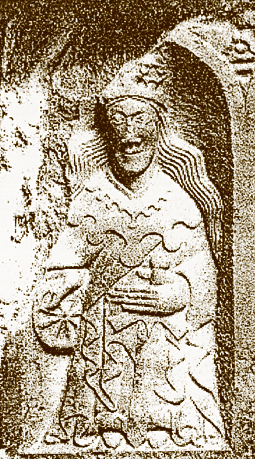 During
the late 1400's and early 1500's there was a particularly strong
cult of St Catherine in Co. Donegal. It was the Normans who first
adopted St Catherine and they more than likely brought her story
to the Irish sometime in the 1100's. We know that the wife of the
Sweeney chief is responsible for pushing devotion of her in Donegal.
Her family in Co. Mayo had in their possession a Latin copy of her
life dating to an earlier period, but she was responsible for getting
Ciothruadh Mag Fhionnghail of Tory to translate it into the language
of the people... Irish Gaelic. The Annals first make mention of
such devotion in the year 1513, the same year that Ciothruadh done
his valuable work on St Catherine. She was apparently known in Donegal
at an early date since we have note of a devotion (on a small scale)
to her at Lough Derg in the south of Donegal in the year 1480, but
it was Ciothruadh Mag Fhionnghail and the Sweeney family who helped
to push such devotion in the north of the county. Devotion to St
Catherine continued within the Sweeney clan but also within the
McGinley clan for another two hundred years or more. Her memory
and devotions were in decline by the 1800's.
During
the late 1400's and early 1500's there was a particularly strong
cult of St Catherine in Co. Donegal. It was the Normans who first
adopted St Catherine and they more than likely brought her story
to the Irish sometime in the 1100's. We know that the wife of the
Sweeney chief is responsible for pushing devotion of her in Donegal.
Her family in Co. Mayo had in their possession a Latin copy of her
life dating to an earlier period, but she was responsible for getting
Ciothruadh Mag Fhionnghail of Tory to translate it into the language
of the people... Irish Gaelic. The Annals first make mention of
such devotion in the year 1513, the same year that Ciothruadh done
his valuable work on St Catherine. She was apparently known in Donegal
at an early date since we have note of a devotion (on a small scale)
to her at Lough Derg in the south of Donegal in the year 1480, but
it was Ciothruadh Mag Fhionnghail and the Sweeney family who helped
to push such devotion in the north of the county. Devotion to St
Catherine continued within the Sweeney clan but also within the
McGinley clan for another two hundred years or more. Her memory
and devotions were in decline by the 1800's.
 One
interesting note in the old records, from the Catholic Qualification
Rolls Index for Donegal 1778-1790, mentions a Patrick McGinlay living
in Kiletter (mistake for Kinletter, Co. Donegal). This index records
the names of Catholics showing acceptance to the British Crown in
Ireland. He is described as a tailor by occupation. He is mentioned
under the date 10-09-1785. This was a list of persons who took an
oath of allegiance to the Crown (of England). Despite showing loyalty
to a foreign ruler, he was still a Catholic. It is clear that many
‘unofficially’ accepted the state of English rule in
Ireland simply to be able to live their lives normally or to be
able to do a trade or business.
One
interesting note in the old records, from the Catholic Qualification
Rolls Index for Donegal 1778-1790, mentions a Patrick McGinlay living
in Kiletter (mistake for Kinletter, Co. Donegal). This index records
the names of Catholics showing acceptance to the British Crown in
Ireland. He is described as a tailor by occupation. He is mentioned
under the date 10-09-1785. This was a list of persons who took an
oath of allegiance to the Crown (of England). Despite showing loyalty
to a foreign ruler, he was still a Catholic. It is clear that many
‘unofficially’ accepted the state of English rule in
Ireland simply to be able to live their lives normally or to be
able to do a trade or business.
The
two places of worship for our clan in the pre-seventeenth century
were the churches at Ballintemple (often called Tullaghobegly Church)
and the church at Ray. According to history, the church at Ballintemple
was named after a local saint called Begley, hence Tullaghobegly.
The Irish spelling is Tullacha Beigile. The name Begley or Beigile
is a corruption of the much earlier Beag Bile. In the Genealogy
of the Saints, he is recorded thus…”Beag Bile, son of
Tighearnach, son of Feargus, son of Aongus, son of Conall Gulban.
He was therefore related to the great Colm Cille, the main saint
of the area. Beag Bile lived in the seventh century. According to
the “Genealogy of the Saints”, his feast day was celebrated
on the 12th October, he is also recorded in the important “Martyrology
of Donegal”. His name was later corrupted in Irish to Beaglaoch
which means ‘little hero’. The ancient graveyard and
ruins of the church are still to be seen. It is said to be one of
the oldest graveyards in the north west of Ireland. The dead of
Cloughaneely (as well as from neighbouring Gweedore) were buried
here until new graveyards were opened at Magheragallon in 1765 and
Gortahork in 1789.
The
church at Ray sits on an ancient religious site. The area was for
centuries occupied by monks. The present church on the site is a
later one that was used by our clan. The exact age of this old church
is not known, but it was in use in the sixteenth and early seventeenth
centuries. The church at Ray was forced from the local people in
the year of 1609 and was said to be in ruins by 1622. According
to Alister Rowan in his “Study of the North West of Ulster”…
’the ruins of the church (at Ray) are late sixteenth or early
seventeenth century. It is likely that it was built on the original
site of the church of St Fionnán. The cross is of the High
Cross pattern of the tenth century’. These two places of worship
are close to the hearts of all McGinleys.
THE MASSACRE AT RAY
c.1642
During
the year of 1642, Doe Castle which rightfully belonged to the Clan
Sweeney, was taken from them by the English authorities. The castle
was put under the leadership of a Captain Robert Conynham. He had
a habit of raiding and attacking the surrounding areas and on one
such raid, he and his soldiers attacked and destroyed the ancient
church at Ray. On that particular day, the church was full with
worshippers, the attack took place on a Sunday. It is believed that
the Bishop for the diocese was present to give Confirmation. This
would account for the church being ‘extra full’. The
‘brave’ English soldiers burst open the doors and killed
everyone they found inside, men, women, children and the clergy.
One man however managed to escape by throwing himself through a
window. He ran as fast as he could across country constantly being
chased by the soldiers. He crossed the River Ray at Drumnatinney.
He travelled up Killult Hill until he was eventually caught. The
soldiers cut his body into pieces as he was saying his final words
to God.
The
bodies of the dead were buried 200 yards from the church at a place
called Lag na gCnámh (hollow of the bones). In the sixteenth
and seventeenth century, the two principal religious places for
the local families, including the main family of the area, the McGinley’s,
was the church and graveyard of Tullaghobegly (the main church for
the parishes of Raymunterdoney and Tullaghobegly up until the year
1610) situated at Ballintemple and the church at Ray. According
to the Hearth Money Rolls for 1665, Tullaghobegly parish was where
most of the McGinley name were found for Co. Donegal. The neighbouring
parish of Clondahork also had a lot. The surname at that time was
very rare in other parts of Co. Donegal. The names of the massacred
are not recorded, but it is very likely that many of the slain were
McGinleys. The church at Ray was said to be in ruins by 1622, so
by the 1640’s it would seem to have been at least temporarily
back in use.
MASS ROCKS
1609-1782
After
the illegal Plantation of Ulster, the Catholic churches and church
lands were confiscated by the English Government. Part of their
fight to wipe out the Irish nation included banning the Catholic
Church and destroying or giving the churches to Protestants. In
1609 the churches of Tullaghobegly and Ray were assigned to the
‘new’ Protestant faith. These were so called devout
religious peoples who saw no wrong in taking away from the native
population their faith, buildings and land. Pococke in his book
‘Irish Tours in 1752’ remarked that the Catholic Church
at Ray had been “forcibly wrestled from its native owners
in 1609”.
Once
the ‘physical’ aspect of their religion had been taken
away from them, the native people had to find some other way to
express their faith and they found the answer in ‘Mass Rocks’.
A Mass Rock was any large rock, located in a remote or hard to find
location that was fairly flat so as to be used as a makeshift alter.
They had to be difficult for English soldiers or authorities to
find. Mass Rocks were to become an important feature on the Irish
landscape (as they are to be found all over the country). They replaced
churches and became a permanent reminder of England’s intolerance
to freedom of Religion. In the Cloughaneely/Tullaghobegly area,
Mass Rocks can be found at Ballintemple, Ballyboes, Baltony, Inishboffin
and Killult. The most important Mass Rocks for the McGinley Clan
were at Ballintemple and even more so, at Ballyboes. During this
whole sorry period, it was common for Irish people to carry on their
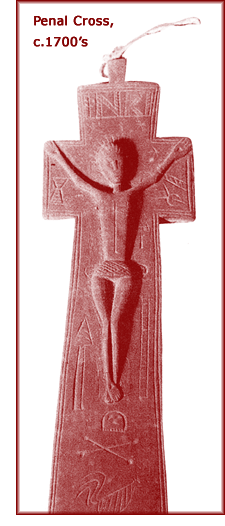
persons ‘Penal Crosses’. These crosses were small, made
of wood, and of a design that enabled it to be easily hidden on
the body. These crosses had short ‘cross-arms’ for this
purpose.
During
these Penal Times, the Catholic Church was near to defeat in Ireland.
Many Priests were close to starvation. Bishop Brenan of Waterford
wrote in the year 1672 that the Priests were so poor that ‘many
of them for their support are obliged to take up farming, cultivate
the land and keep cattle’. Also, Irish Priests run the risk
of being discovered by the ‘priest-catcher’. Anyone
who informed on a possible priest stood to gain a handsome reward!
One of the worst in Ireland was an early settler in Newtoncunningham,
Co. Donegal called John Forward. He was ‘High Sheriff of Donegal’
(an impressive sounding ‘English’ title) in the year
1686. He was recorded as ‘a zealous Protestant and famous
priest catcher’. He also had a great hatred for the Presbyterians
who he described as ‘those who swarm much more in that county
than the Roman Catholics’. In fact the Presbyterians, for
a while, were cursed by the English just as much as the Catholic
Irish.
A
Statute passed by English Royal Decree in 1697 stated that... "Catholics
were prohibited from burying their dead in any cemetry not attached
to a Protestant church". An Act issued on the 4th March 1704
said that "No Protestant should marry a Papist" and "No
Papist should be able to purchase land or take a lease of land for
more than 31 years". This was to stop Catholics from passing
on land to the next generation. It wasn’t until the year 1782
that the laws banning priests and bishops were stopped. Some religious
freedoms were beginning to appear, but it was not until 1786 that
a new Catholic church was ‘allowed’ to be built at nearby
Gortahork. The use of Mass Rocks started to decline after this date
and they soon became an integral part of the Irish culture and landscape.
